With more and more robot awn mowers comng to the market each month it can be hard to pick the right one. The aim of this article is to provide you with the key features you should consider when choosing a robot lawn mower.
Given the rapid development of the market we have focussed on what is most relevant in 2025.
Contents
- How Do Robot Lawn Mowers Work?
- Key Benefits of Using a Robot Mower
- Factors to Consider Before Buying
- Robot Mower Features to Look Out For
- Understanding Navigation and Boundary Systems
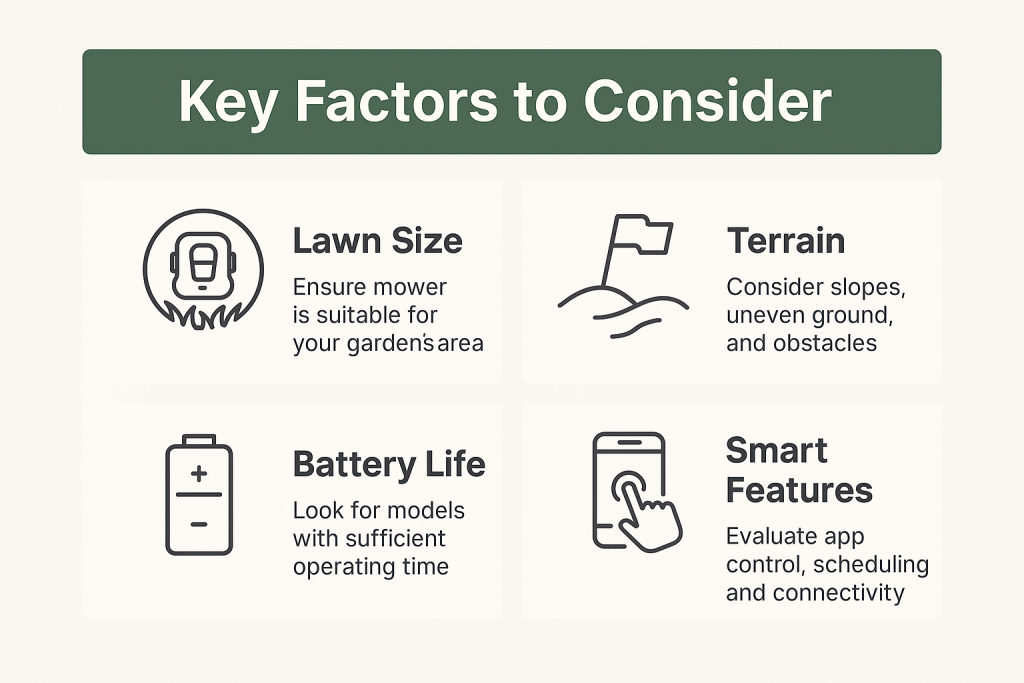
- Lawn Size and Terrain Compatibility
- Battery Life and Charging
- Smart Features and App Integration
- Robot Mower Pricing Explained
- Top Robot Mower Brands in 2025
- Best Models to Consider This Year
- FAQs About Robot Lawn Mowers
- Final Thoughts
1. How Do Robot Lawn Mowers Work?
Robot lawn mowers use a combination of sensors, navigation systems, and rechargeable batteries to automatically cut your grass. Once set up, the mower will travel around your lawn on a programmed schedule, trimming a small amount of grass regularly to maintain a neat and tidy look.
They typically cut with small rotating blades and are designed to mulch clippings into the lawn, meaning there’s no need to collect or dispose of grass.
2. Key Benefits of Using a Robot Mower
- Time-saving: Automates a time-consuming task
- Eco-friendly: Low energy usage and mulching reduces waste
- Consistent results: Keeps grass at a uniform height
- Quieter operation: Runs much more quietly than petrol mowers
- Lawn health: Regular cutting improves grass density and resilience
3. Factors to Consider Before Buying
Before choosing a robot mower, consider:
- Lawn size (in m²)
- Slope and terrain type
- Obstacles (trees, flower beds, paths)
- Weather resistance
- Security features
- Budget and warranty
4. Robot Lawn Mower Features to Look Out For
- Cutting width and height adjustment
- Mulching system
- Weather sensors or rain resistance
- GPS or camera-based navigation
- Smartphone app control
- Scheduling options
- Anti-theft alarms or PIN protection
5. Understanding Navigation and Boundary Systems
Most robot mowers have traditionally relied on boundary wires that you install around the perimeter of your lawn. Installing the wires can be time consuming and a broken wire can stop the mower working and be difficult to find and fix.
More recently techology has advanced and now many models use GPS and/or camera-based navigation for wire-free setup. These systems are much easer to set up and are increasingly accurate and reliable.
Main types of navigation:
- Boundary Wire: Most common and cost-effective. Good for small lawns
- GPS Mapping: High precision, great for large lawns
- Camera Vision (RTK/AI): Adds flexibility by ffering object avoidance and efficient routing
6. Lawn Size and Terrain Compatibility
Robot mowers tend to be rated by manufacturers for different maximum lawn areas. Typical categories:
- Small lawns: Under 1,00 m²
- Medium lawns: 1000–2000 m²
- Large lawns: Over 2000 m²
Terrain can be a big factor too. Be sure to check also for:
- Max incline capabilities if you have a hilly garden
- Ability to handle complex layouts or multiple zones
- Ability to handle uneven surfaces if you have rough ground (useful for rural properties)
7. Battery Life and Charging
Battery runtime and charge time directly affect how long the mower takes to cut your lawn. Some models auto-return to their charging station when the battery is low and resume where they left off.
Look for:
- Lithium-ion batteries
- Automatic charging
- Run times of 60–160 minutes
- Charge times of 60–120 minutes
8. Smart Features and App Integration
In 2025, many mowers offer advanced smart features:
- Bluetooth/Wi-Fi connectivity
- GPS tracking
- Voice control (Alexa/Google)
- Customisable schedules
- Over-the-air software updates
These make setup, monitoring, and troubleshooting much easier.
9. Robot Mower Pricing Explained
Prices vary depending on lawn size capacity, features, and brand. Here’s a general guide:
- Entry-level: £300–£700 (small lawns, basic navigation)
- Mid-range: £700–£1500 (medium lawns, app control, scheduling)
- Premium: £1500–£4000+ (large lawns, GPS, RTK navigation, AI)
Remember to factor in installation kits, base stations, accessories or professional setup services.
10. Top Robot Mower Brands in 2025
- Husqvarna Automower – Reliable, feature-rich, and great for complex gardens
- Worx Landroid – Value for money and modular accessories
- Mammotion LUBA – GPS/RTK navigation without boundary wires
- Gardena Sileno – Great for small to medium lawns
- Stihl iMow – Powerful and durable with strong brand backing
- Segway Navimow – Advanced AI navigation and sleek design
11. Best Models to Consider This Year
- Husqvarna Automower 405X – Best for mid-sized complex gardens
- Worx Landroid S300 – Top budget pick for small lawns
- Mammotion Luba AWD 5000 – Best GPS mower for large lawns
- Gardena Sileno Minimo – Best for beginners
- Segway Navimow i105E – AI-powered, boundary-free mowing
12. FAQs About Robot Lawn Mowers
Q: Do robot mowers work in the rain?
A: Most models are weatherproof, though mowing in heavy rain isn’t ideal.
Q: Can I use a robot mower without a boundary wire?
A: Yes, some models like the Mammotion Luba or Segway Navimow use GPS instead.
Q: Are they safe around pets and kids?
A: Yes, most have sensors that stop the blades if lifted or bumped.
Q: How long do robot mowers last?
A: With proper care, 5–8 years is common. Batteries may need replacing sooner.
13. Final Thoughts
Investing in a robot lawn mower can save you time and keep your garden in top shape year-round. With options now available for all lawn sizes, budgets, and tech preferences, there’s never been a better time to make the switch. Use this guide to narrow down your choices and find the perfect match for your lawn in 2025.